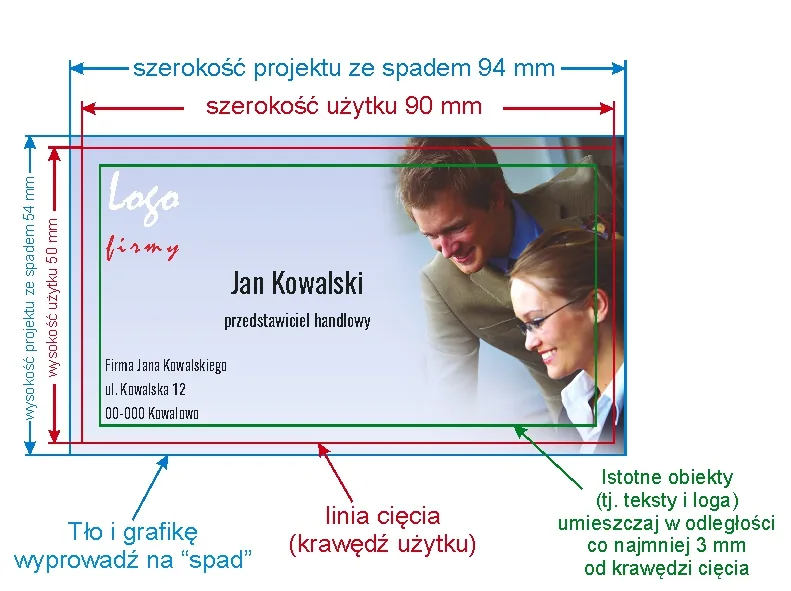
90x50mm
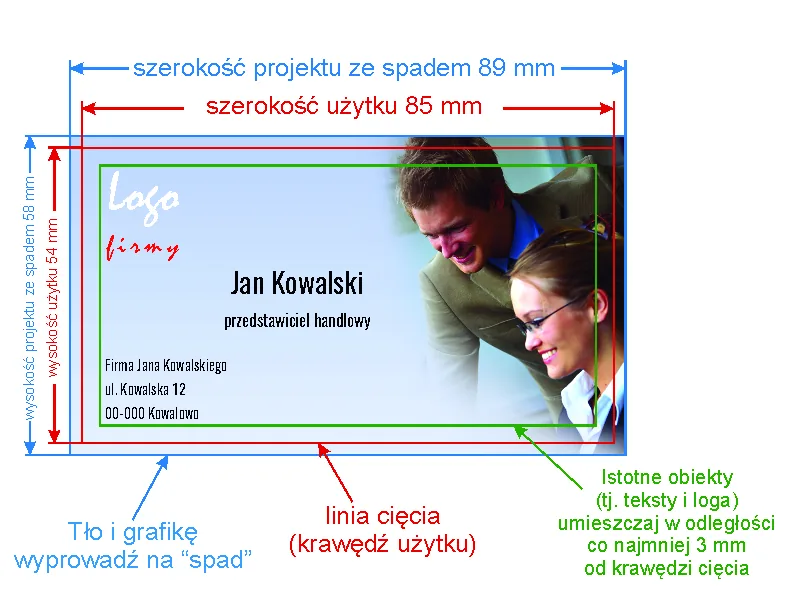
85x54mm
At a glance
- CMYK
- 300 dpi resolution
- 2 mm bleed
- safety margin for content min. 3 mm from the trim line
- black must use C:0 M:0 Y:0 K:100
- grey, e.g. C:0 M:0 Y:0 K:60
- text converted to outlines
- no ICC color profiles
- PDF version 1.3 (Acrobat 4.0)
Dimensions
Trim size
The trimmed size is 90x50mm or 85 x 54 mm. (see illustration)
Design size (with bleed)
The print file must be 94x54 mm or 89 x 58 mm, i.e. 2 mm larger on each side compared to the trim size. If objects extend beyond the design area, they must be trimmed off. (see illustration)
If the business card is in portrait orientation (54 mm wide, 85 mm tall), prepare it in that orientation (rotate the template by 90 degrees)
Important!
Even if your artwork has no background extending to the edge, the design size must still be respected. Therefore limit the design size with a 89 x 58 mm rectangle on the lowest layer, with no outline and no fill — or (for raster files) crop the file accordingly so it has the correct dimensions.
We turn the sheet along the vertical axis (left-right, not top-bottom), sheet flipping instructions
Template
To make designing easier, we offer templates you can download and use as a starting point.
Files:
85x54: PDF or CDR
Important! (applies to CDR) the template is a design aid — if the bleed area (dashed line) is not visible, enable View->Show->Bleed. Guide lines indicate the safe content area. Please do not change the page format.
Bleed
The artwork background and any objects touching the trim edge must extend beyond the trim edge into the bleed area. For this product the bleed is always 2 mm on each side.
Graphics
Color mode
The artwork must be prepared in CMYK. If the file contains raster images (textures, photographs), they must also be converted to CMYK. 
For a full, deep black use C:0 M:0 Y:0 K:100 and save it as vector graphics.
Avoid gradient transitions to values below 5%.
Add noise to gradients to prevent banding.
Optimal resolution
The optimal resolution for raster graphics and photographs is 300 dpi.
Element placement
Important elements (photos, graphics, text) cannot be closer than 3 mm to the trim edge or fold lines (creases, folds).
When rotating the artwork by -90 degrees, check that bitmaps rotate correctly.
Place all text on a separate (top) layer.
When saving as CDR, group the artwork and convert text to outlines.
The page format must match the design size above, and the artwork should be centered on the page.
When saving as EPS without a (white) background, limit the artwork with a frame matching the design size above.
Due to cutting tolerance, slight shifts of the artwork relative to the trim edges may occur. We therefore advise against placing any kind of frames around the artwork — non-centered placement may be visible. In such cases we recommend a safety margin of at least 5 mm from the trim line.
Saving the file
File formats
Preferred: PDF (PDF 1.3, Acrobat 4.0)
Accepted: TIFF, JPG (not recommended)
Notes
If the artwork contains text, remember to convert it to outlines or embed fonts in the file (for PDFs) before saving.
For double-sided business cards, save all sides in one file (front, back). If the chosen format does not support this, create two separate files named front and back. (artwork_front.tiff, artwork_back.tiff).
When ordering multiple designs but the back side and the print run are the same for all, we accept fronts sent separately and a single back in a separate file.
When ordering multiple designs with different print runs, be sure to add the quantities at the end of each file name, e.g. „card_company_100pcs.pdf" „card_personal_200pcs.pdf". Please do not enter print runs in the order comment.
If you save the file from Photoshop, be sure to choose TIFF — save the file as a single layer, without additional alpha channels.
For complex designs with many layers, overlapping graphics, shadows, transparencies etc., flatten them as much as possible into a single background image while keeping text, logos, lines and other important elements as vectors.
Additional information
Please note that due to differences in print and display technologies, color variations may occur compared to inkjet prints or on-screen images.